
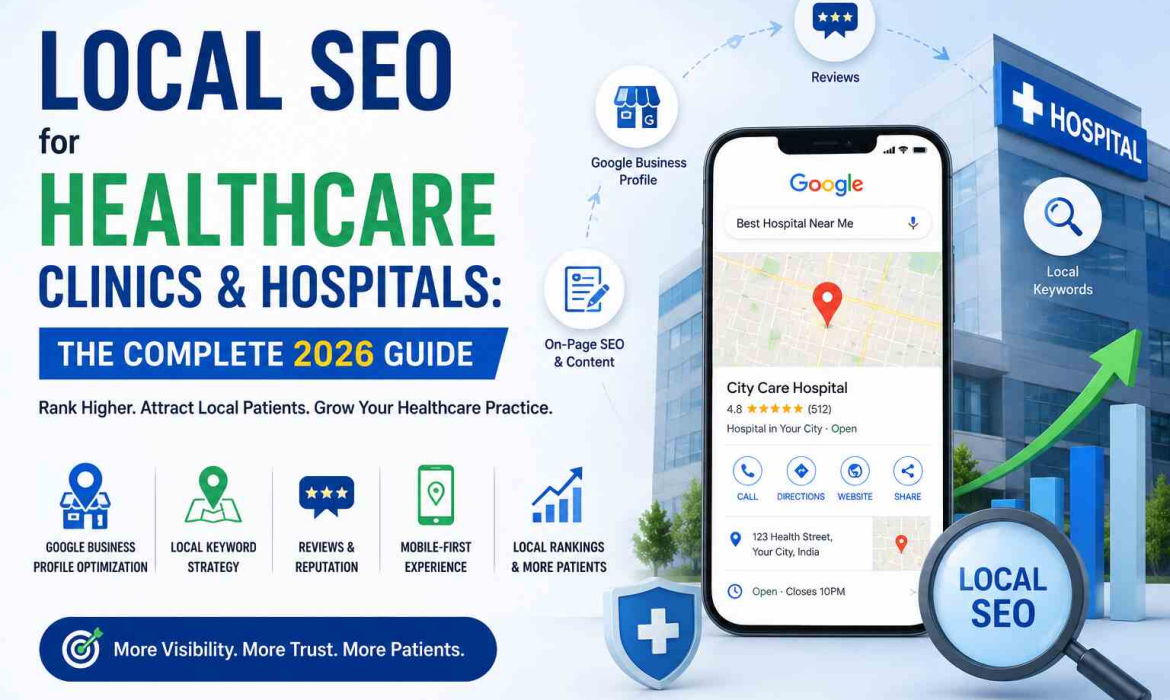
Local SEO for healthcare clinics has become the front door to the patient pipeline, not a marketing extra. Research from Deloitte’s Global Health Survey puts the number of patients who research providers online before booking at 82%. And 71% say they read reviews before choosing a doctor. Searches for “doctor near me” have grown roughly 185% since 2020. For hospitals and clinics, local SEO is the mechanism that gets you found by the patients already searching for you. Here’s a practical, step-by-step guide to doing it well in 2026.
Why Local SEO for Healthcare Clinics Matters More Than in Almost Any Other Industry
Local SEO for healthcare clinics matters because healthcare is a trust-first, proximity-driven decision. A patient searching “pediatrician near me” wants a provider who is close, credible, and available soon — not the most generic result on page one. Roughly 54% of traffic to healthcare websites already comes from organic search. Practices that publish helpful, patient-focused content generate close to 4.8x more inquiries than those that don’t. On top of that, close to half of patients (47%) say they’ve switched providers after a poor online experience. A slow website or inconsistent listing information can cost you a patient before they ever call. Compare that experience to a well-run restaurant’s social presence — both live or die on first impressions formed entirely online.
Local SEO for Healthcare Clinics Starts With Your Google Business Profile
The single highest-leverage step in local SEO for healthcare clinics is claiming and fully optimising your Google Business Profile. Make sure your profile includes:
- Your exact legal practice name (no keyword-stuffing, which violates Google’s guidelines)
- Correct address, phone number, and service area
- Accurate categories (e.g., “Dermatologist,” “Multispecialty Hospital”)
- Real photos of your facility, team, and reception area
- Complete, accurate operating hours, including holiday hours
- Insurance accepted, languages spoken, and accessibility information
Respond to every review — positive and negative — professionally and promptly. Review responses are a visible trust signal to both patients and Google.
Local SEO for Healthcare Clinics Requires Consistent NAP Data Everywhere
A core technical piece of local SEO for healthcare clinics is Name, Address, and Phone (NAP) consistency. Your details should match exactly across your website, Google Business Profile, Practo, Justdial, Facebook, and any medical directories you’re listed on. Inconsistent data confuses Google’s local ranking algorithm. It also erodes patient trust.
Local SEO for Healthcare Clinics Works Best With Location and Specialty-Specific Pages
Done well, local SEO for healthcare clinics means a multi-location hospital has a dedicated page for each combination. “Cardiology at [Clinic Name], Ahmedabad” performs far better in local search than one generic services page trying to rank for everything. Each page should include the specific services offered at that location and the doctors practising there. Add location-specific content too, like nearby landmarks and parking details.
Local SEO for Healthcare Clinics Extends to Content, Reviews, and Mobile Speed
Beyond listings, local SEO for healthcare clinics benefits from content that actually answers patient questions. Patients typically visit around 5.4 different websites during their research process. Answers to “What should I expect during my first visit to a cardiologist?” build trust and keep you visible across that research journey. This is also where E-E-A-T matters most: content should be written or reviewed by a qualified medical professional, with their name and credentials visible.
Layer on a steady stream of authentic reviews, fast mobile load times, and click-to-call or WhatsApp booking. A patient in pain won’t wait for a slow site or hunt for a hidden “Book Appointment” button. Structured data — Physician, MedicalClinic, MedicalOrganization schema — rounds this out. It helps Google understand your specialties, accepted insurance, and location precisely.
Measuring Local SEO for Healthcare Clinics: The KPIs That Actually Matter
Tracking local SEO for healthcare clinics properly means looking past raw traffic to the metrics that reflect real patient demand. Google Business Profile insights — calls, direction requests, website clicks — usually matter more than blog traffic for a single-location clinic. They map directly to appointment intent. Alongside that, track keyword rankings for “[specialty] + [locality]” terms rather than generic national terms. Watch the ratio of new-to-returning organic visitors. Track review velocity and average rating trend too. A clinic that only watches overall sessions can miss the fact that its Google Business Profile, not its blog, is driving most of its qualified local demand.
Local SEO for Healthcare Clinics vs. Paid Patient Acquisition
Local SEO for healthcare clinics competes with paid channels for the same appointment slots, so it helps to know the trade-off. Organic listings and Google Business Profile clicks typically cost far less per booked appointment than paid search or portal listings once rankings mature, though they take longer to build. Paid channels deliver bookings immediately but keep costing per click indefinitely. Most clinics get the best result by running both together: paid search to fill the pipeline now, while local SEO compounds in the background. For a fuller breakdown of that trade-off, see our guide to PPC vs SEO.
A Simple 90-Day Local SEO Roadmap for Clinics
| Phase | Focus | Key Actions |
|---|---|---|
| Weeks 1–2 | Foundation | Audit and fully complete your Google Business Profile; fix NAP inconsistencies across directories |
| Weeks 3–6 | Pages | Build or refresh location and specialty pages; add medical schema markup |
| Weeks 7–10 | Content | Launch a patient-question content series (FAQs, condition guides, procedure explainers) |
| Weeks 11–13 | Reputation | Set up a systematic review-generation process and monitor rankings for key local terms |
Common Local SEO Mistakes Clinics Make
- Duplicate or outdated Google Business Profile listings: Old locations, incorrect hours, or duplicate profiles from a previous management company confuse patients and hurt rankings. Audit for duplicates before doing anything else.
- Ignoring negative reviews: Not responding, or responding defensively, damages trust more than the review itself. A calm, professional response shows future patients how you handle concerns.
- Generic “Our Services” pages: A single page listing ten specialties rarely ranks well for any of them individually. Each specialty deserves its own focused page.
- Stock photography instead of real facility photos: Patients, and Google, respond better to genuine photos of your actual clinic and staff.
- No mobile appointment booking: Forcing a patient to call during business hours instead of booking online loses appointments to competitors who make it easier.
Note: patient research, review, and ROI statistics cited above are industry-wide figures from third-party healthcare marketing research, not Hawkium client data.
Frequently Asked Questions
How important are online reviews for local SEO for healthcare clinics?
Extremely. Reviews are a top local ranking factor and directly influence whether a patient calls you — 71% read them before choosing a provider.
Should every hospital department have its own webpage?
Yes, where possible. Specialty-specific pages consistently outperform a single generic “our services” page for local, specialty-specific search terms.
Is content written by a marketing team enough, or does it need a doctor’s input?
Google’s E-E-A-T guidelines specifically reward medical content that is written or reviewed by qualified professionals. This matters most for YMYL (Your Money or Your Life) topics like health.
How does local SEO for healthcare clinics differ from general SEO?
It leans much more heavily on proximity, trust signals, and structured business data than broad content SEO. Patients typically search and decide within a tight geographic radius.
Hawkium’s SEO agency works with healthcare providers across Gujarat to build local visibility that turns searches into appointments. For the broader trends shaping search this year, see our guide to SEO trends 2026, and explore our complete digital marketing services for hospitals and clinics.


