
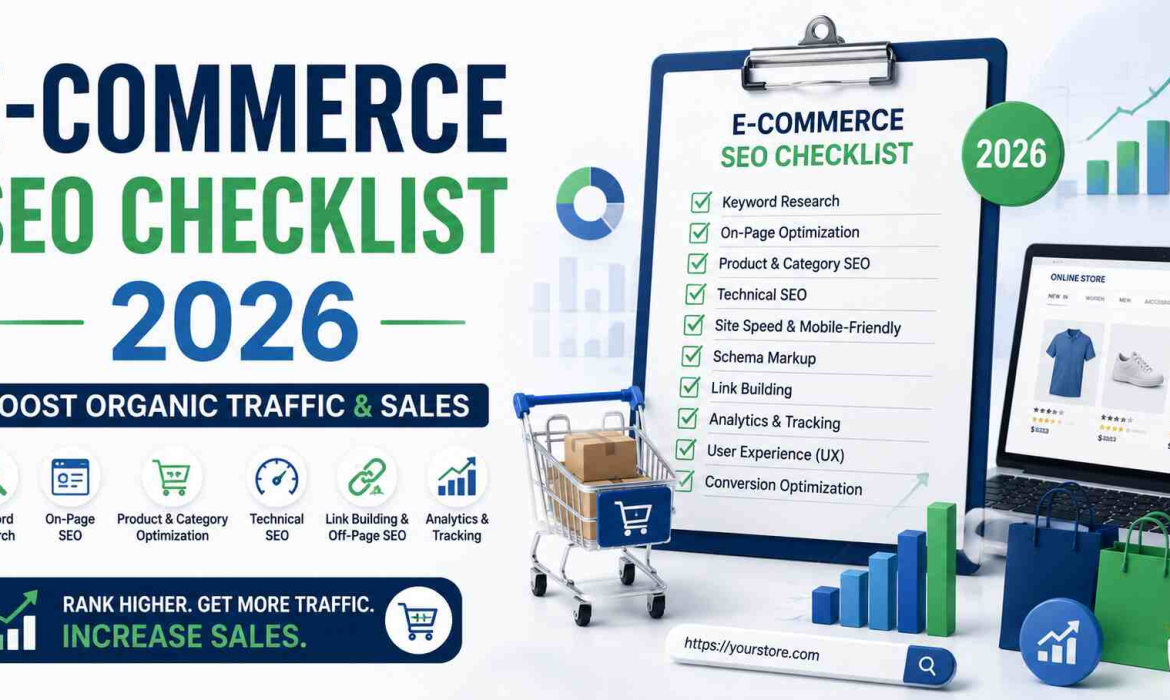
An ecommerce SEO checklist earns its place on every online store’s to-do list. Organic search remains the single largest traffic source for online stores, accounting for close to 40% of all ecommerce website visits. Unlike paid ads, that traffic keeps arriving long after you stop actively spending on it. But ecommerce SEO has its own rules: thousands of near-duplicate product pages, filtered navigation that can create crawl traps, and a constant tension between conversion-focused copy and search-friendly content. This ecommerce SEO checklist walks through what to get right in 2026, groundwork you can implement before working with an ecommerce SEO agency on execution.
Ecommerce SEO Checklist Step 1: Fix Your Technical Foundation First
Every ecommerce SEO checklist should start with technical health. Content and links can’t compensate for a site Google struggles to crawl, or a page that’s too slow to convert. Compare this to real estate listing pages, where the same speed problem quietly kills inquiries.
- Site speed: A one-second delay in page load time can cut conversions by roughly 7%. Compress images, use a CDN, and minimise render-blocking scripts.
- Mobile experience: More than half of ecommerce transactions now happen on mobile devices. Mobile-first design isn’t optional.
- Crawl efficiency: Faceted navigation can generate thousands of low-value URLs. Use canonical tags, noindex on filtered combinations that don’t deserve to rank, and a clean XML sitemap.
- Fix duplicate content: Near-identical product descriptions dilute rankings. Write unique descriptions for at least your top-selling and highest-margin products.
Ecommerce SEO Checklist Step 2: Structure Categories Around How Customers Actually Search
The next item on any ecommerce SEO checklist is category architecture. Category pages — not individual product pages — usually rank for broader, higher-volume terms like “running shoes for women.” Invest in category page content. A genuinely useful intro paragraph helps, along with clear filtering and internal links to relevant subcategories and buying guides.
Breadcrumb navigation reinforces this structure for both users and search engines. It shows the path from homepage to category to product, giving Google clear signals about how pages relate. Sites that skip breadcrumbs or bury categories several clicks deep often see slower indexing of new products and weaker category-level rankings.
Ecommerce SEO Checklist Step 3: Write Product Pages That Rank and Convert
A properly executed ecommerce SEO checklist treats every product page as its own landing page. Each one should include:
- A unique, benefit-led product description, not just a spec list copy-pasted from the manufacturer
- High-quality images with descriptive alt text
- Customer reviews — pages that display reviews can see conversion increases of up to 270%, and 93% of consumers say reviews influence their purchase decisions
- Structured data (Product schema) so price, availability, and rating can appear directly in search results
- Clear, crawlable internal links to related and complementary products
Ecommerce SEO Checklist Step 4: Use Video and a Content Layer Above the Catalogue
Further down the ecommerce SEO checklist is rich media and top-of-funnel content. Adding video to a landing or product page can lift conversion rates by up to 80%. Short demonstration videos, sizing guides, or unboxing content also increase time on page, a positive engagement signal. Above the catalogue itself, buying guides and comparison posts capture searches your product pages can’t reach on their own. This content should link down into relevant category and product pages, spreading authority through the site.
Ecommerce SEO Checklist Step 5: Personalisation, Email, and Lifecycle Revenue
A complete ecommerce SEO checklist doesn’t stop at the click. Personalised recommendation modules like “customers also bought” can lift conversion rates by up to 26%. They also create extra internal linking pathways that help Google discover more of your catalogue. Once SEO earns the visit, email marketing helps you monetise it repeatedly. It delivers an average return of around $42 for every $1 spent, making it one of the highest-ROI channels to pair with organic acquisition.
Ecommerce SEO Checklist Step 6: Handle Out-of-Stock and Seasonal Products Correctly
The final step in this ecommerce SEO checklist is one online stores get wrong most often. Don’t delete out-of-stock product pages that have earned rankings and backlinks. Keep them live with clear “back in stock” messaging and alternative product suggestions. Or 301 redirect permanently discontinued products to the closest matching category.
Measuring Ecommerce SEO Performance Beyond Rankings
An ecommerce SEO checklist isn’t complete without a way to measure whether it’s working. Track organic revenue and organic conversion rate separately from overall traffic, since a traffic spike that doesn’t convert isn’t a win. Watch category-page rankings for your highest-volume terms, not just individual product rankings, since category pages usually carry more of the traffic weight. Monitor crawl stats in Search Console for sudden drops, which often signal a technical issue before it shows up in traffic. And track page-level bounce rate on your top category and product pages, since a high bounce rate on a well-ranking page usually points to a speed or content-mismatch problem worth fixing first.
Quick-Reference Ecommerce SEO Checklist
| # | Action | Impact |
|---|---|---|
| 1 | Audit site speed and mobile usability | Prevents conversion loss from slow load times |
| 2 | Resolve duplicate content and crawl-trap issues from filters | Protects crawl budget and rankings |
| 3 | Write unique descriptions for top-selling products | Removes the most common ecommerce SEO penalty risk |
| 4 | Add Product and Review schema markup | Enables rich results (price, rating) in search |
| 5 | Build category-page content and buying guides | Captures broader, higher-volume searches |
| 6 | Add video to key product and landing pages | Up to 80% lift in conversion rate |
| 7 | Turn on review collection and personalised recommendations | Up to 270% and 26% conversion lifts respectively |
| 8 | Set up proper redirects for discontinued products | Preserves earned rankings and backlink equity |
Common Ecommerce SEO Mistakes to Avoid
- Blocking category/filter pages entirely with robots.txt: This can prevent Google from discovering products altogether. Use canonical tags and selective noindex instead of blanket blocking.
- Thin category pages with no content: A category page that’s just a product grid struggles to rank for the broader terms that matter most.
- Slow checkout and product pages on mobile: Over half of transactions happen on mobile. Mobile performance testing should be a recurring task, not a one-time fix.
- Losing rankings on discontinued products: Deleting a page instead of redirecting it throws away earned authority that took months to build.
- No internal linking strategy between guides and products: Buying guides that don’t link down to relevant products waste their traffic-generating potential.
Note: conversion-lift and traffic-share figures above are industry-wide benchmarks from third-party ecommerce research, not Hawkium client data.
Frequently Asked Questions
Should I write unique descriptions for every single product?
Ideally yes, but prioritise your top-selling and highest-margin SKUs first if resources are limited. Duplicate manufacturer copy is the most common issue this ecommerce SEO checklist is designed to catch.
Do product reviews really affect SEO, not just conversions?
Yes. Review content adds fresh, unique, keyword-rich text to product pages and can trigger star-rating rich results, which improve click-through rate from search.
What’s the biggest ecommerce SEO mistake you see?
Deleting or blocking out-of-stock and discontinued product pages instead of redirecting them, which throws away earned rankings and backlink equity.
How is an ecommerce SEO checklist different from general on-page SEO?
It has to account for scale, faceted navigation, and product-specific structured data — issues a typical service-based website never encounters.
Hawkium’s ecommerce SEO team helps online stores fix technical issues, build content that converts, and grow organic revenue sustainably. If you’re weighing organic against paid channels for your store, our guide to PPC vs SEO breaks down the cost and ROI differences, and you can browse our full digital marketing services.


